Friday, September 4, 2015

YL in Ecuador

Our last afternoon in Quito we had the privilege of connecting with Ivan, who is the National YL director for Ecuador. This was a bit out of the blue as we had emailed many months ago but were not expecting to connect as he was taking kids to camp in the southern part of the country during the week that we were in town. But late the night before our last day, his wife emailed and asked if we would be available as it happened that he was going to be in Quito (which is about 5 hours from their home).

We ended up connecting at a local mall and had a very blessed time. This was a large mall even by American standards and we actually walked into the very door he was waiting at - which we had no idea at all and we were actually dropped by our angry taxi-man a different door than we wanted. Truly incredible!

It was amazing to hear all that God is doing here in Ecuador as YL is only about 3 years old. Ivan saw a need to keep teens growing in their faith and he more or less self started YL without knowing anything about YL or that it even existed!  He even called it La Vida Joven and decorated his home, the meeting place for 'club' gatherings, with this name.  Later he learned that there was an actual organization called YoungLife and La Vida Joven, and connected with Dan Jessup (South America head YL guy who's a friend of a good friend) and was brought on staff with YL. His progress in Ecuador in 3 short years is nothing short of impressive, God is definitely at work through this young man and the vision he has to spread the Gospel to teens. Below is the email with a list of prayer requests from Ivan and a photo of a map with their vision.
Ivan Hahn, Ecuador YoungLife director

Hi Matt,
Glad that it worked out for Ivan to meet you and your family!  I've added you to the e-mail list so you can see our updates and it also has a link to my blog.  I am attaching a map of Ecuador.  The green markers indicate where we have established club/ministry (Cuenca, Shell, Puyo, Calderon, Quitumbe) and the yellow markers indicate potential places to begin based on contacts we have or as part of our goals for the next 5 years (Guayaquil, Galapagos Islands, Ambato, Esmeraldas, Mera, Santa Clara). 

One of our prayer requests would be for God to raise up leaders and adults who are willing to support and volunteer with Young Life in those potential areas.  We pray for wisdom and clarity to know God's plan and timing.  Pray for our leaders as they impact the lives of teenagers.  Pray for the 63 campers who recently made a decision to follow Christ at camp, to grow in their faith and find a Christian community of believers (church) to connect to.  Pray for our financial needs, both personally and for the ministry.  As YL continues to grow and expand so do our financial needs.  Please pray for the thousands of teenagers in Ecuador who still need to hear the message of hope. 

Thank you!

Rachel and Ivan 
 
to subscribe:


Thursday, September 3, 2015

Greetings (and goodbye) from Quito

[Between being busy and spotty internet we did not get to regularly update (hence the title) during our week, but here is a summary of our time in Quito.]

Door to door it took us about 22 hours to get from San Pedro to Guatemala City to Mexico City (yes, wrong direction but they were free tickets) to Quito. We left San Pedro early because of potential disruptions due to protests in Guatemala City regarding corruption with the Vice President (and now President), but were able to navigate them without incident. This meant we had a lot of time to kill in a very small airport. We found an open space and proceeded to calmly pass a mini soccer ball around - that lasted about 25 seconds before we were reprimanded.

In Mexico City security we were forced to pull out every electronic device separately for the first time ever. This was quite a chore but ended without incident (except that one child left his electronic bag in security which we thankfully noticed quickly after the fact).  We boarded our flight in Mexico City at about 1AM and landed just before 6AM local time. We were then taken to our new home which is another Airbnb place. Here we have more space, a TV, and separate bathrooms. We also have laundry (the 15 loads by hand were fun but....), we can drink from the faucet and put toilet paper in the toilet, which does actually swirl the opposite direction! Needless to say, we will enjoy luxuries that we now appreciate more than ever, having not had them for the last month.

Quito sits at about 9400 feet and is huge. We knew from the start that we would only be about to scratch the surface here as we need to get a lot of school done because the next two weeks will be tough to accomplish much.  

Day 1
Having barely slept on the plane it goes without saying we were exhausted. All in all though the kids did great. We slept for about two hours and then headed out with 3 missions: lunch, SIM cards and groceries. Our place here is more out in the suburbs and there is a true mall nearby which contained all 3 of our objectives. We had our share of mishaps and communication issues but untimely got the 3 chores done in about double the time it should have taken. The funniest was trying to get from the grocery store back to our place. The groceries got put in the trunk and the driver took off with only half of us in the car. The half in the car didn't have our address and because we were both trying to call each other the calls were not connecting. Eventually we got the driver to turn around and collect the other half of the family. The driver was quite gracious with us as we couldn't stop laughing because we couldn't exactly state our address correctly.... We just keep saying "more" to go further down the street as he drove 20 yards and stopped followed by another 20 yards and so on. 

While here we had no definite plans which was nice. Here is the view from our new place.

Off in the distance is Volcano Cotopaxi which is experiencing violent tremors of late and being watched very closely. Here is a link to recent story. http://www.wired.com/2015/08/cotopaxi-continues-rumble-ecuador-prepares-eruption/  This is about 30 miles away so we didnt believe we were in immediate danger, but it could've certainly make things interesting.

Day 2 - Saturday
 We enjoyed getting to spread out in some space of our own and catch up a bit on life electronically.  However wifi was spotty and we still have to figure out some of our apps and systems to make school go a bit smoother.
     We went to a park where the locals tend to hang out and played a bit of soccer.  We attended a college soccer game at a local stadium.  This was interesting as it was not heavily attended and we joked that there were more riot police there than fans!

Day 3 - Sunday
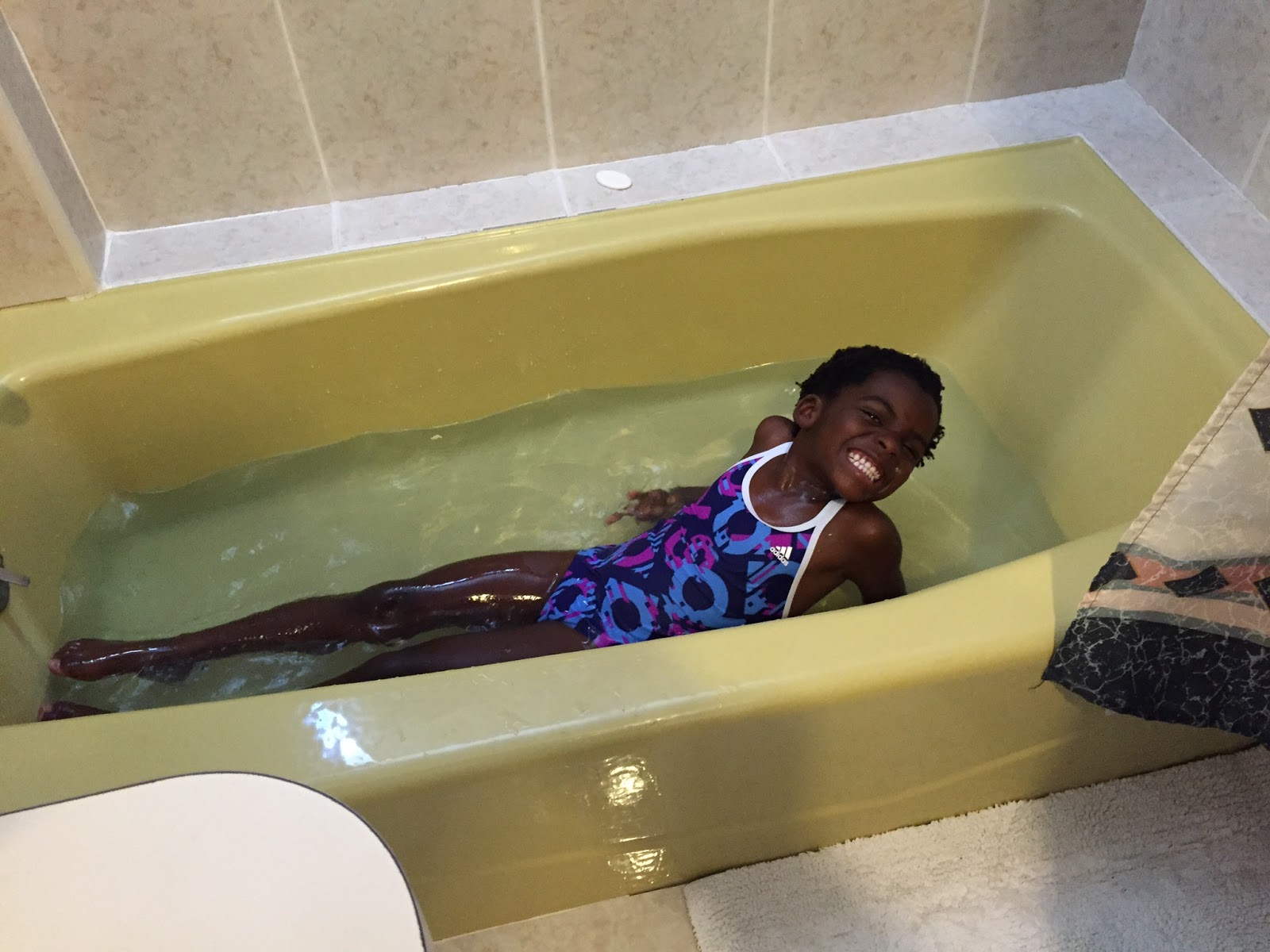
We are on the same time zone as home here, so we watched the live feed of our church from home via computer which was a real treat. We enjoyed Cinnabons we had purchased the night before because today our beautiful daughter turned 4!!  Happy Birthday SJ!
New swimsuit birthday present!!
Later, we experimented with the public bus system as we headed up to Mitad Del Mundo which is a location on the equator with museums, monuments and all sorts of hands-on educational displays. It is about 40 minutes north of Quito and was a very cool experience. The site was built in 1979 but modern technology has proven the line drawn is 262 yard off the actual equator. The actual equator though is a line 5KM wide as 0'0'0" changes throughout the year depending on the earth's rotation, translation and nutation (yes, that's a word). Supposedly on June 21st exactly 0'0'0" approaches the yellow line.

Monument housing museum and hands-on activities

Panoramic from top of monument


The day concluded with a meal of SJ's choice which meant ice cream and Papa Johns pizza - yes that's right, they are here, along with Pizza Hut, Dominoes and many other American fast-food establishments.

Day 4 - Monday
We headed into the old city and took a 3.5 hour free (excluding the highly requested tip) walking tour which was excellent. This free tour provided all sorts of history and information about the city pointing out museums, churches, government buildings, currency, wars and food options to name a few. It was a great way to get high level info so as to decide what else we wanted to do during our stay in Quito. Because it was Monday we were able to see the Changing of the Guard at the Presidential palace but not gain access to any museums as they are all closed on Mondays.

Presidential Palace
Panoramic of Royal Plaza

Raising of the flag
Day 5 - Tuesday
Was supposed to be a half day of school that stretched into a full day - ugh

Day 6  -Wednesday
School in the morning and then headed out to check out museums and more of Old Quito. We did many interesting things including visiting the original Jesuit church (with baroque architecture covered in gold leaf), a currency museum, the museum of San Francisco which housed some amazing art work originally developed to help the Spanish explain Christianity to the natives, and lastly we circled back to La Ronda which is a very artsy part of Quito with lots of crafts shops and excellent dining. None of the museums really allow photos, so these are "unofficial".
Small portion of the church
Garbage bins rise up to reveal larger containers

Day 7 - Thursday
Today we explored the "Telefrico" which is a gondola that rises up above 13,000 feet over the city. Amazing views were had from all directions as were chilly temperatures. We ended this day with a surprise YoungLife connection - but will do a separate post on that.


13,000 feet - Part of the city of Quito
Panoramic view

So much more we could have done here as we barely scratched the surface. Equally so much more we could say but we head to the Galapagos at 4am (which is less than 6 hours away) and we need to get a few hours of sleep!


Wednesday, August 26, 2015

Goodbye Guatemala

Yesterday was our last day in Guatemala and we ventured over to another little town called San Marcos which is very small and quint and known as sort of a spiritual hippie town. We didn't do much beside walk around and have lunch but it was neat to see another distinctive location around Lake Atitlan. San Macros is much smaller than San Pedros and certainly felt more laid back. Truly wish we had more time to explore the lake and the other Lagunas more but perhaps another time.

We have spent 26 full days in Guatemala and have loved each one. The people here have been wonderful and willing to help at any request. We never once felt the least unsafe or threatened. The food has been great and, for the most part, we remained healthy, which is quite a feat during the first month based on others experience. We got cell phones working and were able to navigate our three locations with no major hitches. We do miss being able to turn on the faucet and drink or actually being able to throw your toilet paper in the toilet (have to put in trash here if you didn't know because their plumbing can't handle paper) and certainly our own beds, but the experiences we have gained here will remain with us for a lifetime.

We leave today for a long journey to get to Ecuador. We used miles to book the tickets so it's not the most direct route. It will take almost 22 hours in total due to our location and layovers. It's been great being in one country for almost a month and we are excited (and a little uneasy) as we consider our next month which is much more complicated with flights, boats, layovers and unique aspects of our plans.

All in all though we feel ready to move on and while we could easily spend more time here, we feel content.

Thank you Guatemala - I'm sure we will return someday!

Sunday, August 23, 2015

Chichicastenango - a Mayan Education

Chichicastenango, is a small town in the Western Highlands of Guatemala, known for being the home of the largest market in Central and South America (possibly all the Americas).  The market is crammed into 20 blocks filled with vibrant colors, shoulder to shoulder people, and hosts flowers, weavings, live chickens, raw/butchered meat, freshly made tortillas, fruits, vegetables, wood carvings, second hand clothes, shoes, and more. 

Because of its location, a 2012 consensus estimates that 98% of the people are indigenous with many others coming here to buy and sell.  The people and their dress are beautiful.  We were told that taking a photo too close would capture their spirit, and so we did our best to be respectful and non-invasive.  Below is a slideshow we put together from our day at market.


According to the Joshua project, "70 percent of these indigenous people are animists, who revere spirits in nature and of ancestors.  About 30 percent are Christians, but their impact has been minimal.  Mayan religion pervades traditional rites, customs, and ways of thinking.  In recent years, foreigners have stirred a resurgence of interest in Mayan worldview, along with its religious practices."

We hired a tour guide to explain some of the Mayan history and practices that we were seeing take place.  This was amazingly informative and interesting.

Santo Tomas Church

Above is the Santo Tomas Church.  It is currently a Roman Catholic church that shares in worship with the Mayans.  When the Spanish arrived here there was an ‘X’ on the land where the church is.  The Spanish thought this was a bad sign and destroyed it and tried to build a church on the sight.  However, the church kept falling down.  A local shaman (Mayan priest), named Pasqual, offered to help the Spanish build their church in return for a stone from the completed church.  In 1545 when he received his stone, Pasqual was told to take it very far away from the church, so he went up the mountain and disappeared, never to be seen again.  

The place where the Mayans found Pasqual’s stone became the place where they made their sacrifices to their gods.  (Mayans used to sacrifice humans but when the Spanish came, they convinced them that chickens and animals could take the place of human life for sacrifices.)  One day a Mayan prayed for Pasqual’s return and got other Mayans to come up and pray for the same thing.  Then they realized that the stone that had been given to Pasqual resembled a human face.  While Pasqual’s remains have never been found, to this day the Mayans wonder if maybe the sky god turned Pasqual into the stone.

Meanwhile, the Spanish read the Mayan bible and realized the ‘X’ wasn’t evil but instead represented the 4 directions of the Earth (North, South, East, and West).  The church of Santo Tomas was built on the Mayan’s North site, which is where they go to pray for light and good things.  On the opposite side of the city is another site where the Mayan go to pray for dark things, black magic as they refer to it.  Mayans do not believe in police, so if they are wronged, this is an example of when they would go to the shaman at the South/dark site to pray for revenge or bad things to happen to their wrong doer.  The Mayans believe that there was a creator of life and that the creator took the four colors of corn and combined them to get different races and skin colors. 

The Catholics and the Mayans both use the Santo Tomas Church as their own.  There is a crucifix on the wall and mass is held here.  However, down the main aisle and throughout the church are areas where Mayans come to light candles and pray.  Along with the Catholic priest, there are also shamans who sit in the church and advise people.  Mayans also offer burnt sacrifices on the steps leading up to the church.
The Catholic church controls the walls and pews

Mayan prayer candle line the center floor

Each of the 18 steps leading up to the church relates to a month in the Mayan calendar year (18 months consisting of 20 days each, plus an additional 5 days for a total of 365 days to a calendar year).   When a baby is born, the shaman is immediately consulted and a book is read predicting the baby’s personality, strengths, struggles, and path in life.  The details of this prediction depend on the year, date, time of day and other factors, and much of the child’s life will be determined by this reading. 

18 Steps for the Mayan months and behind the boy is smoke coming from a recent sacrifice

The extra 5 days in a Mayan calendar year are used for days to decide and commit to making a major change in one’s life (for example stopping being an alcoholic).   In front of the church is a large pole.  People who decide to make a major life change will climb up this pole, tie themselves to it at the top, and then jump off!  Similar to bungee jumping, but more extreme!  We found a framed picture of this in one of the local shops.  It was explained to us that these people are showing their commitment to change and the pain that goes with that!

This is a picture of a picture as this only occurs on Dec. 18th

Growing up Mayan is not easy.  Because Mayans do not believe in doctors, when they get sick they go see a shaman.  The belief is that one is sick because of something bad they did, so they are hit with sticks and beaten until they have confessed all of the bad things that might have led to their illness.  Then they feel better.  Being that the shaman is also a doctor, he mixes up herbs for medicines and healings and is consulted for health purposes, often using a temazcal, a Mayan sauna, in the healing prescription.  When a woman is one month pregnant, she goes to visit the shaman.  She is required to go in the sauna and the shaman massages her belly and foretells the baby’s health while in the womb.

Shaman sauna

There is no divorce in the Mayan culture because when a couple wants to marry (which can happen as early as 12 or 13 years old), they bring their shamans together a month prior to the wedding date to meet and discuss their compatibility.  Going back to each of their paths based on the date and time they were born, should there be anything alarming about their paths joining together in harmony, the shamans would not marry the couple.  Being in love has no impact on this.  Most marriages are free choice, but some Mayan marriages are arranged and in some instances a dowry must be paid.

The Mayans have many gods that they pray to and worship.  San Simon is a popular god as he is god of the ladies.  Women present their requests to him (in a statue form) and then give him a lit cigarette.  If the cigarette stays lit, the request will be granted, but if the cigarette goes out quickly, the woman is not allowed to present her request again for another full year.  San Simon also enjoys receiving alcohol and somehow it gets poured into a funnel in his mouth, which will increase his favor towards the lady.

San Simon with cigarettes and booze

We hiked up to where the Mayans make their sacrifices and where Pasqual’s stone is to this day.  While up there, a sacrifice was being made for a man, praying that good things would come his way (maybe a new job, positive opportunity, or kind gesture).  The man sacrificing and praying layered chocolate brownies into a cone shape, filled the middle of the cone with jelly beans and other sweet delicacies and then placed light colored candles around the sacrifice.  He lit the candles, covered his head, and read from a prayer book.  Meanwhile the man who was being prayed for received a call on his cell phone, so he started talking to someone, while the other man was sacrificing for his well being!  We asked if this was considered rude or bad manners and was told that it was not.

Actual Mayan "sacrifice"

Prayer recital (with a phone call)

Near the rock of Pasqual there are what seem to be a pile of crosses, which caused us to wonder their significance.  However, we learned that they are actually the Mayan ‘X’ and that one is placed their every time a shaman dies and his name is written on it.

Center stone is Pasqual's rock

Finally, we saw from a distance the colorful city cemetery.  All religions are buried in this cemetery.  The colorful mausoleums belong to the Catholics and Mayans who celebrate the Day of the Dead, while the plain cement mausoleums are the Evangelicals, who do not celebrate the Day of the Dead.  On November 1st each year, the Catholics make large salads with different meats in it and pass them out for their celebration, while the Mayans make a drink with the four types of corn.

Cemetary

We learned so much more about conquistadors, festivities, masks, and celebrations, but have shared some of the details that fascinated us the most.  While it is interesting to learn about another culture and religion and think back to their history, we are so grateful to know Jesus Christ as our Lord and Savior.  To know that Jesus was the ultimate sacrifice, that He took the burden of our sins when He died on the cross, and that as Christians we are redeemed by His blood and not our own efforts.  The Bible tells us in Acts 4:11-12 that this Jesus is the stone that was rejected by you, the builders, which has become the cornerstone.  And there is salvation in no one else, for there is one name under heaven given among men by which we must be saved.
Kids posing with Conquistadors

Saturday, August 22, 2015

San Pedro & San Juan

Our journey from El Paredon to San Pedro started out a bit questionable as the car we were in kept dying every 1000 feet.  Dad would get out and twist some wires while the driver gave the car some gas and then we would go a bit further.  Thankfully the drive that we thought was going to be 20 minutes only ended up being about 5!  We then piled our large packs into a little fishing boat and were taken across the river to another shuttle which drove us the 2.5 hours to Santiago, Guatemala, going from sea level to over 5000 feet.  Dad put us on a boat to San Pedro, where our Airbnb stay is located, while he journeyed to a local hospital, ATM, and pharmacy to get to the bottom of his ear pain (swimmer’s ear), which made the journey from El Paredon rough for him.

The place we are staying in San Pedro is referred to locals as ‘The Titanic’ as it has a Titanic-like balcony overlooking Lake Atitlan.  It is a 3 level town-home-type place and is a mix of a traditional Guatemalan style design with some modern updates, meaning that it is a unique layout with some funky aspects.  There are 2 bedrooms near the entrance on the bottom floor, each bedroom has a full bed.  There is a bathroom with a shower and while water is limited, this is the first place we’ve had a warm shower in over 3 weeks!  There is also the carved out area for a sink/scrubbing fixture that Guatemalans use.  Upstairs is the kitchen, a bedroom with a queen bed, a living room, and a small closet with a toilet and the sink for the kitchen (so this is where we wash our dishes).  The top floor is a flat roof with railings, it has a beautiful view with a shaded seating area and bar.  We eat our meals and do schoolwork up here.  It is nice to have some space to spread out for a couple of days and we are happy here with no set plans.

Lake Atitlan is a beautiful volcanic lake in the Western Highlands of Guatemala.  It is surrounded by mountains and several volcanoes along with many little villages that boats ferry to throughout the day.  The lake level fluctuates rapidly, it is said to have a 60 year cycle and has sometimes risen up to 18 feet in one month!  However, they are currently experiencing a drought and have blue algae in the lake, so it is not recommended that we swim in the area we are staying.  The temps are much milder here and we all wear sweatshirts at night.

Saturday we boated over to San Juan to see what was there to do.  We learned about weaving and using natural dyes from plants instead of the many artificial dyes used by the majority of Guatemalans.  We ended up hiking half way up Indian Head Mountain at the hottest time of day!  

Boat ride to San Juan
The Indian's forehead is to the left behind the kids, then his nose and chin extend to the right.

We had a local guide who was amazed at SJ’s determination to hike on her own, and G’s build when he took off his shirt - ha!  

Along the way we hiked by coffee fields and learned about how they grow and harvest the coffee bean.  Many Guatemalans claim to be the top producers of coffee; however according to world statistics they are about tenth in line.  

Coffee beans

The guys wanted to hike the entire mountain but we decided it was best for the family due to how steep it was and how little daylight was left, if we turned around at the half way point.  It was good exercise, a perfect adventure, and gave us a great view of the lake! 
Hiking Indian Head Mountain
Overlooking Lake Atitlan on the way up
View from the lookout half way up the mountain


Friday, August 21, 2015

El Paredon

El Paredon

Greetings, we have spent the last 10 days in a very small village on the west coast of Guatemala called El Paredon, which, literally, means “the sand wall”. We did not do updates while there because the Internet at our lodging had two modes: slow or broken. [We are at our new location now which has wi-fi].

There's so much to say about this place it’s hard to know where to begin, as it is so unique. We had a fantastic time and honestly could've stayed longer. At the same point, we were ready to move on and felt very content with our time and efforts in El Paredon.

General Info
Typical Beach Day
This is a vast beach with no people - literally. There is our small place, another small hotel and a newly opened hostel and that is it. On any given day you would not see more than 30 people on the beach and over half of them would be surfers in the water.  While they’re amazing local surfers, we learned that many of the parents in the village don’t let their kids surf so there are even fewer than you’d expect.

El Paredon is a village of about 1000 people. It consists of about 5 square blocks, and all of the roads are black sand.  It is not uncommon to find a random dog, horse, rooster or even pig wandering around the streets.  Virtually every local we met had lived here their whole lives. The only exception was an Israeli couple who visited here a few years ago and loved it so much that they saved up to return and opened a small restaurant (a large cheese pizza cost $5 and we ate several). Most the grandparents we met have been in their same home all their lives. Motorcycles are how most get around (if not walking) with the occasional car or 4-wheeler also being seen.  There are no police, and no crime and everyone is extremely content. Most fathers fish while the mothers stay home. School exists but it does not seem to be emphasized too terribly much.  Tourism is not prevalent here, so it’s difficult to see how they sustain themselves, but somehow it works. Several families operate very small stores (tiendas) which all seem to sell the same things.

What makes this place unique is that there is only one road to get to the village which then ends at a river, so it’s not the easiest to get to.
Road to El Paredon
Its about 20 minutes by car on a very bumpy dirt road after the pavement runs out (ironically at a private gated community for wealthy Guatemalans). One oddity is that even though this is Guatemala’s west coast the beach actually faces straight south. This means the sun rise and sunset are to our left and right as opposed to setting over the ocean like one would expect. 

While it is currently rainy season in Guatemala, there has been little rain this year.  When it does rain, it is typically at night.  We were able to see several storms while there and they were incredible!  The temperature during the day in El Paredon is in the mid-90's, but with humidity feels like 105-110.  The mosquitoes were a slight bother at dawn and dusk, but nothing bug spray didn't keep away.

Our Lodging
View from our bed :)
Main level - nets hanging from ceiling & 2 beds under futon
Front of Casita - "school day"


The place we stayed was the called The Surf House and sits right on the beach. It’s a small hotel/hostel with different types of lodging offerings from a hostel-like room set up all the way to private casitas, which is where we stayed.  Our little home had a main floor with a futon and small counter and an upstairs with a double bed. The entire casita was open air, meaning there were no glass windows, so we slept in mosquito nets at night. We had two kids on single mattresses on the floor and two sharing the futon. This and the kids stuff took up the entire main floor. We have our own bathroom with private outdoor shower (a pvc pipe run through bamboo – one temp only) and working toilet. 
All in all, the place is awesome!  It’s very quiet during the week and quite busy on the weekends as locals come to surf. That is typical most of the year they say.


Shower


In the common area, there was a fridge with beverages (which is on the honor system – a clipboard where you write your name and what you took), and a freezer with ice cream treats. Big breakfasts cost about $3-5 with lunch being slightly more and then for dinner everyone eats the same 3-course meal together at one big table, family style, for $10 each. The staff is extremely friendly and ranges from full time workers, to volunteers working for room and board. We have met locals as well as people from Spain, Switzerland, Holland, California, Nicaragua, Costa Rica, and Australia. We thoroughly enjoyed the location and people here.

Our Activities
Our time was spent mostly between hanging out at the beach and working with a local organization that focuses on trying to better the community. The volunteer side was challenging to figure out as communication was a little difficult (though not because of language) but once things got moving, we really enjoyed it. We spent time painting the walls of a new secondary school, helping at recess by introducing new sidewalk games, mom taught art class, and our oldest impressed the children with his map drawing skills as well as taught some guitar.  We also enjoyed surfing and playing in the waves, chatting with a local grandmother who invited us to her church (which we attended) and playing soccer (some village kids played barefoot while others wore cleats).  We ate a BBQ dinner at local family's home, boated up the river to see large sea turtles and paddled through the mangroves catching crabs and viewing that unique ecosystem. We brought one crab back and had the kitchen cook it up for us – the kids thought it was delicious! We also took a short trip to San Jose, which is a large port town and famous for the United Fruit Company, which at one point in history controlled the entire country’s fruit exportation business. There we ate fresh sushi and saw some of the local daily catch. Our last day the hotel manager invited the local soccer team to come and swim and BBQ to celebrate their recent success at some tournament. He invited the kids to participate which was a very sweet gesture.
BBQ Diner at local family home
Some of T's art students
Our oldest giving a guitar lesson to Danny
Teaching a new game
Painting school wall
Drawing the globe freehand garnered attention

G's buddies
Korean sushi in San Jose. Friend on left from Australia.
Lots of reading was done

Local catch in San Jose
Local soccer team celebration

For the most part everyone is healthy but we have had our first bouts with injury and illness here. Surfing has had its way with us as the waves are big, fast and strong here. Dad's whole body is sore for the effort.  Just getting out is dangerous as you can see in the pictures. We have several ear infections, a cut toe and foot (nothing serious), some vomiting & high temps,  and even some burnt feet from the black sand here, which gets extremely hot during the afternoon if you have to grab a screaming child who stops as it burns their little feet. 

We also experienced our first earthquake tremor. This was nothing major as not everyone in our camp felt it.  We think that only those up in the lofts were able to feel it because they were above ground, but mom & dad were about to yell at some kids (early in the morning) because we thought they were shaking the headboard of our bed!

As we post this we have just arrived at our third and final Guatemala location and it is different from where we have been so far. We have gone from the ocean to a large lake about 5000 feet above sea level. Fewer mosquitoes, no sand, and much cooler temps are certainly welcome!